

Starting a business in Montenegro is easier than most people expect. A limited liability company needs just €1 of founding capital, the registry usually issues its decision within a few working days, and annual profit up to €100,000 is taxed at 9%. Most founders get through the notary, the registry and the bank in about two weeks.
The harder stretch begins once the company exists. You now have a tax number, a bank account and fiscal software, and the real question is how a country of roughly 620,000 residents, plus millions of summer visitors, finds out you are open. The steps below follow the order that tends to work on the ground, from checking the idea to running your first promotional season.
Key Takeaways
- A limited liability company (d.o.o.) can be founded with €1 of capital and registered at the CRPS within days.
- Foreigners can own 100% of a Montenegrin company and register it through a local power of attorney.
- Corporate profit tax is progressive at 9%, 12% and 15%, which keeps it among the lowest in Europe.
- VAT registration becomes mandatory once your turnover passes €30,000 in any 12 month period.
- Every sale has to be fiscalized and reported to the Tax Administration in real time.
- Promotion works best when you plan it around the tourist season, Google visibility and local recommendations.
Plan the Launch Before You Register Anything

A registered company costs money every month, even before it makes a single sale. The director has to be employed and paid at least the minimum wage, payroll returns go to the tax office monthly, and the fiscal software comes with a subscription. A few weeks spent testing the idea can stop you paying those costs for a business the market was never going to support.
Check demand where and when you plan to sell
Montenegro behaves like two different markets. According to Monstat, August 2025 brought about 245,000 tourist arrivals in hotels and other collective accommodation, the highest monthly figure on record, and more than nine in ten overnight stays that month were on the coast.
In winter the same streets in Budva or Kotor go quiet, so a seaside café and a software service for Podgorica firms need completely different plans. Talk to potential customers, and write down which months will actually bring money in.
Put promotion into the budget from day one
Many founders budget carefully for the notary, the lease and the equipment, then find nothing left for the launch itself. Set a monthly promotion budget before you sign anything, and decide who will run it. If you’d rather hand brand development, digital campaigns and content creation to a team that knows the local market, VegaPlus marketing services cover exactly that for companies in Montenegro.
It also helps to treat cash flow the way growing companies do, and these smart financial strategies before scaling are a good way to set realistic numbers early.
Register the Company Step by Step
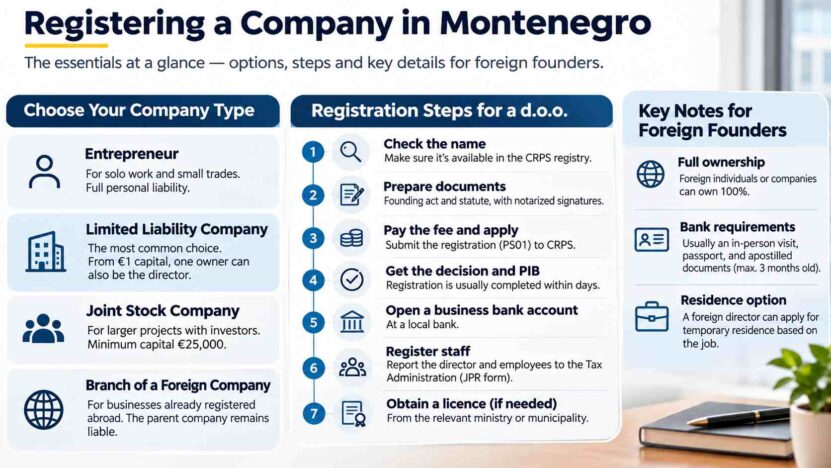
Registration goes through the Central Register of Business Entities (CRPS), which issues the registration decision and gives your company its tax identification number (PIB). The government’s official guide to registering a company and employees lists the forms, and the CRPS registration fees are published in the Official Gazette. You don’t have to be in the country for most of it, because a local representative can file everything with your power of attorney.
Choose the legal form
Most new founders choose between registering as an entrepreneur (preduzetnik) and setting up a limited liability company. The entrepreneur form has less paperwork, but the owner is personally liable for debts, and a foreign entrepreneur needs temporary residence and a work permit before registering. The table compares the options people use most often.
| Legal form | Best suited for | What to know |
| Entrepreneur (preduzetnik) | Freelancers and small local trades | Personal liability for debts; foreigners need temporary residence and a work permit first |
| Limited liability company (d.o.o.) | Most startups and foreign owners | €1 minimum capital; one person can be both owner and director |
| Joint stock company (a.d.) | Larger ventures with several investors | €25,000 starting capital deposited at incorporation |
| Branch of a foreign company | Firms already registered abroad | The parent company stays liable for the branch’s obligations |
The registration sequence
For a d.o.o., the usual order looks like this. Some steps overlap, so you can prepare the bank documents while the registry is processing your file.
- Check that your company name is free in the CRPS online search.
- Prepare the founding act and statute, and have the signatures certified by a notary.
- Pay the registration fee and submit the application on form PS01.
- Receive the registration decision with your PIB, usually within a few working days.
- Open a business bank account at a local bank.
- Register the director and any employees with the Tax Administration using the JPR form.
- Get a licence from the relevant ministry or municipality if your activity requires one.
Extra steps for foreign founders
Foreign individuals and companies can own 100% of a Montenegrin company. Banks usually want to see you in person to open the account, and they will ask for your passport plus apostilled documents no older than three months.
A foreign director employed by the company can use that job to apply for temporary residence, and the U.S. Embassy’s guide for new investors names the Montenegro Investment Agency as the first official contact.
Set Up Taxes, Payroll and Fiscal Invoicing
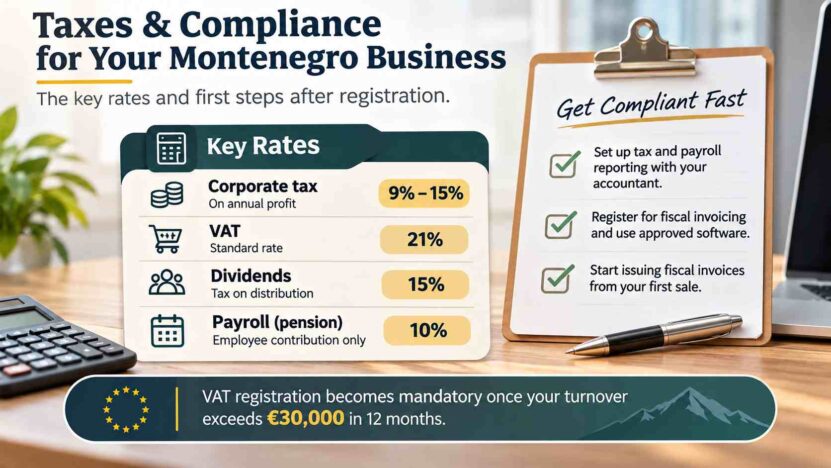
Once you are registered, tax obligations run every month, so set them up properly before you send your first invoice. The rates are low, but the reporting rules are strict. Late or missing returns can bring fines even in months when you owe no tax.
The rates that apply to a new company
These are the numbers most founders need in their first year. Plug them into your financial plan so pricing and salaries make sense from the start. Your accountant can then adjust the details to your activity.
- Corporate profit tax: 9% up to €100,000, 12% on the part between €100,000 and €1.5 million, and 15% above that
- VAT: 21% standard rate, with reduced rates for selected goods and services
- VAT registration: mandatory once turnover passes €30,000 in 12 months, voluntary below that
- Dividends: taxed at 15%
- Payroll: employees pay a 10% pension contribution, and the employer’s pension share was cut to zero under the Europe Now 2 reform
Tax rules here are still changing as the country moves toward EU membership. In 2026, Parliament adopted a new VAT law aligned with EU standards. Ask your accountant which of its provisions already apply to your business.
Fiscal invoices from the first sale
Every sale has to be fiscalized, whether the customer pays in cash, by card or by bank transfer. Your software sends each invoice to the Tax Administration in real time and gets back a unique code and a QR code that the customer can check.
Before you start trading, register your business premises and operators on the Tax Administration’s online portal, get a qualified electronic certificate, and install fiscal software from a registered provider. Fiscal invoices are one of the first things a tax inspector asks to see, so the system needs to work from day one.
Promote the Business Where Your Customers Already Look

Montenegrins spend a lot of time online. A Monstat survey found that 88.1% of households had internet access in 2025. That means competition for attention, so promotion should start in the first week.
Get found on Google and on maps
Set up a Google Business Profile with accurate hours, real photos and a working phone number, then ask your first customers to leave reviews. On the coast, launch campaigns in March and April, because that is when people plan their summer. These ways to improve your website ranking cover the basics that help a small site show up higher in search results.
Use word of mouth and local partners
According to the OECD SME Policy Index 2026, small and medium firms produce about 76% of Montenegro’s value added. Teaming up with neighbouring businesses, like a dive centre and a beach bar, brings customers to both sides. Over time, that steady visibility is how marketing turns an unknown brand into a recognised one.
Frequently Asked Questions
Final Word
Registering a company in Montenegro takes days, while building its reputation takes a full season or two.
Plan your budget with promotion included, set up taxes and fiscal invoicing before the first sale, and time your campaigns around when your customers actually spend.
If you get those pieces in place early, your first year can go into growing the business, not fixing avoidable problems.