
A healthcare architect specialises in the planning and design of buildings used for medical and health-related purposes. These can include hospitals, GP surgeries, clinics, mental health facilities, care homes, and research centres. Unlike general architectural work, healthcare design must respond to complex operational, regulatory, and human needs, balancing technical requirements with patient wellbeing and staff efficiency.
The Complexity of Healthcare Environments
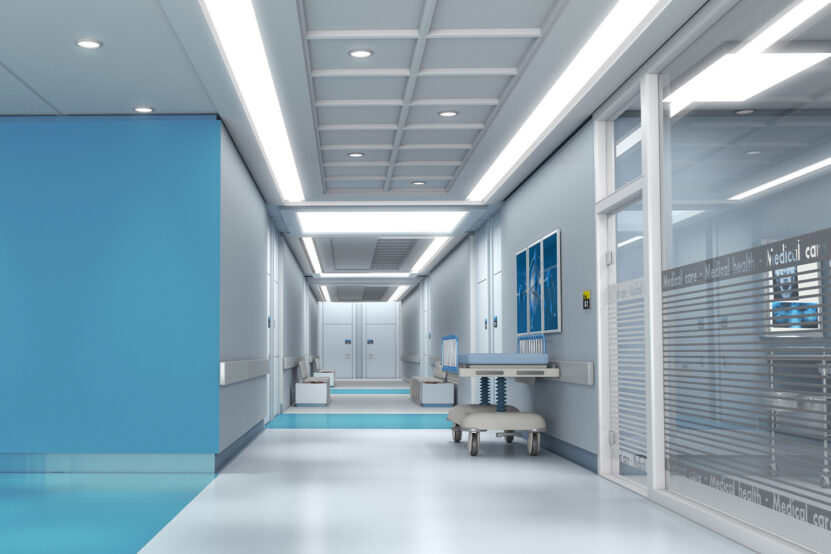
Healthcare buildings are among the most complex structures to design. They must accommodate advanced medical technology, strict hygiene standards, and high volumes of people moving through the space daily. A healthcare architect needs to understand clinical workflows, infection control measures, and the relationships between different departments, such as emergency care, diagnostics, wards, and outpatient services.
Design decisions can directly affect patient outcomes. This reliance on rigorous data is known as Evidence-Based Design (EBD). Architects utilize credible research to justify spatial choices—such as proving how specific lighting spectrums affect circadian rhythms—transforming architecture from a purely aesthetic pursuit into a measurable clinical tool. For example, the placement of nursing stations, the width of corridors, and the proximity of treatment rooms can influence response times and staff fatigue. These considerations make healthcare architecture a highly specialised discipline.
Patient-Centred Design Principles
Modern healthcare design places significant emphasis on patient-centred environments. Natural light, access to outdoor spaces, noise reduction, and intuitive wayfinding are all important factors. Beyond simple planting, this involves ‘biophilic design‘—mimicking natural geometries and airflows to lower blood pressure and cortisol levels. It acknowledges that a connection to the natural world is not a luxury, but a biological necessity for healing. Research has shown that well-designed healthcare spaces can reduce stress, support recovery, and improve overall patient experience.
A healthcare architect must consider diverse patient needs, including mobility impairments, sensory sensitivities, and mental health conditions. Crucially, this inclusivity extends to neurodiversity and dementia-friendly design. For patients with cognitive impairments, high-contrast visual cues and distinct landmarks are vital for independent navigation. Architects avoid complex patterns on flooring that might be perceived as obstacles, instead using colour coding to gently guide movement, reducing anxiety for vulnerable users. This often results in designs that prioritise clear layouts, calming materials, and flexible spaces that can adapt to changing clinical practices.
Supporting Healthcare Staff Through Design

While patient needs are central, staff experience is equally important. Healthcare professionals often work long, demanding shifts in high-pressure environments. Poorly designed buildings can contribute to fatigue, inefficiency, and errors.
Design strategies may include providing adequate staff rest areas, clear sightlines for supervision, and logical adjacencies between frequently used spaces. This concept often involves creating distinct ‘on-stage’ and ‘off-stage’ zones. By separating public corridors from clinical logistics routes, architects reduce congestion and allow staff to transport waste, laundry, or sensitive equipment without navigating through crowded waiting areas, thereby maintaining professional dignity and operational speed.
Storage, equipment access, and staff circulation routes all play a role in supporting daily operations. A healthcare architect must collaborate closely with clinicians and administrators to ensure that the building supports how care is actually delivered.
Regulatory and Technical Requirements
Healthcare buildings are subject to extensive regulations and standards. In the UK, these include Health Building Notes (HBNs), Health Technical Memoranda (HTMs), building regulations, and accessibility requirements. Compliance is essential not only for legal reasons but also for safety and functionality.
A healthcare architect needs a strong understanding of these frameworks and how they apply to different types of facilities. This includes requirements around ventilation, fire safety, medical gas systems, and electrical resilience.
Post-pandemic resilience has further complicated these specifications. Architects must now design for surge capacity, enabling standard wards to convert into intensive care units via upgraded medical gas outlets and switchable pressure regimes that can isolate airborne pathogens instantly. Integrating these technical systems into a coherent and functional design is a key challenge of the role.
Sustainability in Healthcare Architecture

Sustainability has become an increasingly important consideration in healthcare design. Hospitals and medical facilities are energy-intensive buildings, often operating 24 hours a day. Reducing environmental impact while maintaining clinical performance is a growing priority.
Sustainable strategies may include energy-efficient building envelopes, low-carbon heating systems, water conservation measures, and the use of durable, low-maintenance materials. A healthcare architect must balance long-term operational efficiency with upfront construction costs and the need for future adaptability.
Adapting to Technological Change
Medical technology evolves rapidly, and healthcare buildings must be able to adapt. Spaces designed today may need to accommodate new equipment, digital systems, or changes in care delivery models within a relatively short timeframe.
Flexibility is therefore a core principle in healthcare architecture. Furthermore, the integration of telemedicine is reshaping spatial allocation. It is no longer just about housing heavy MRI machines; architects must now design acoustically isolated, data-rich ‘virtual consult’ pods. These spaces require specific lighting and backgrounds to ensure remote diagnostics are accurate, bridging the gap between physical infrastructure and digital care.
This can involve modular layouts, accessible service zones, and structural systems that allow for future expansion or reconfiguration. Designing for adaptability helps extend the useful life of healthcare facilities and reduces the need for disruptive renovations.
Collaboration and Multidisciplinary Working
Healthcare projects typically involve large, multidisciplinary teams. Alongside architects, there may be engineers, clinicians, infection control specialists, project managers, and planners. Effective collaboration is essential to ensure that design decisions align with clinical needs and operational realities.
A healthcare architect often acts as a coordinator, translating complex medical requirements into spatial solutions. This requires strong communication skills and an ability to balance competing priorities throughout the design and construction process.
The Broader Impact of Healthcare Architecture

Beyond individual buildings, healthcare architecture can influence communities and public health more broadly. The location, accessibility, and integration of healthcare facilities within their surroundings affect how easily people can access care. Well-designed facilities can also contribute positively to neighbourhoods, providing welcoming, dignified spaces that reflect the importance of health services in society.
As healthcare systems continue to evolve, the role of the healthcare architect remains central to shaping environments that support care, wellbeing, and resilience for both patients and professionals.